
Low-Water Front Yard Plants That Actually Survive a Hot American Summer
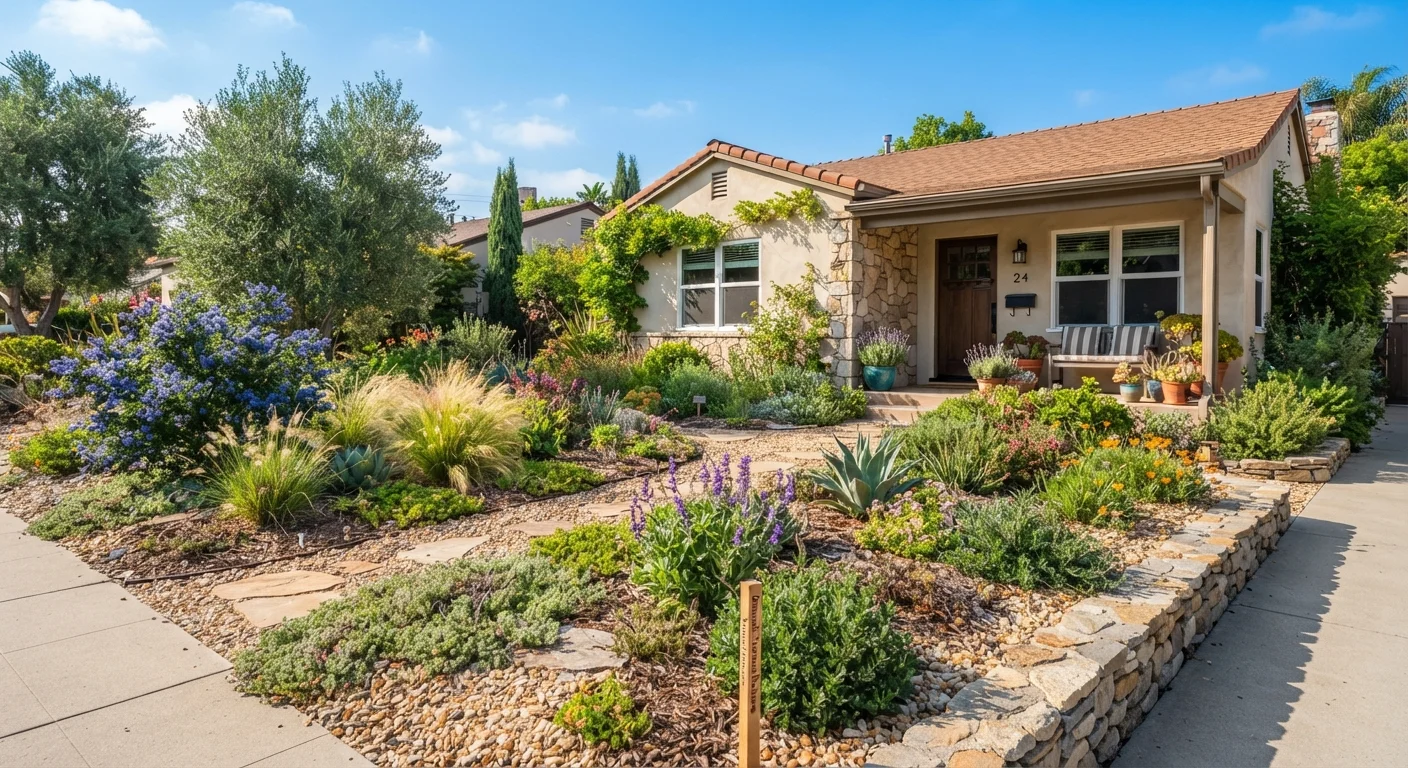
Photo credit: featuredbuzz.com
In this article
Explore drought-tolerant ground covers, shrubs, and perennials suited to warm U.S. climates that reduce watering time and ongoing maintenance costs.
Key Takeaways
- Native and drought-adapted plants can survive hot summers with little to no supplemental watering once established.
- Replacing thirsty turf with low-water alternatives can meaningfully reduce your outdoor water bill.
- Most drought-tolerant plants are low-maintenance, cutting back time spent weeding, fertilizing, and watering.
- Proper soil prep and mulching at planting time are the biggest factors in long-term plant survival.
- Mixing ground covers, perennials, and shrubs creates visual depth without requiring constant upkeep.
Why low-water plants make sense for American front yards
Water costs have climbed in most U.S. regions, and summer watering restrictions are now common in states ranging from Texas to Arizona to the Carolinas. A front yard planted with drought-tolerant species handles heat without daily irrigation, stays presentable through dry spells, and costs less to maintain year after year.
Most of the plants below are native to North America or well-adapted to its climate zones. They perform best when planted in fall or early spring, which gives root systems time to settle before summer heat arrives. Pairing any of these plants with a 2- to 3-inch layer of organic mulch slows moisture loss and suppresses weeds. For more on getting mulch depth and timing right, see our guide to mulching garden beds.
Lavender (Lavandula spp.)
Lavender handles long dry stretches well and grows in most U.S. climate zones, including the Southwest, the South, and Pacific Coast states. It produces fragrant flowers through summer that attract pollinators without any fertilizer. Plant it in well-drained soil and full sun; it declines quickly in poorly drained clay. After the first season, established lavender rarely needs watering outside of a prolonged drought. Prune it lightly after flowering to keep a tidy shape at the front of a bed.
Established lavender rarely needs watering outside of a prolonged drought.
Black-eyed Susan (Rudbeckia hirta)
This native prairie perennial blooms yellow through summer and into fall and tolerates heat, humidity, and dry soil once established. It self-seeds freely, so a small initial planting can spread across a bed over two or three seasons without replanting costs. Black-eyed Susan grows well across USDA Zones 3 to 9, making it one of the most widely adaptable choices on this list. Deadheading prolongs blooming but is not required; leaving seed heads also provides winter bird habitat.
A small initial planting can spread across a bed over two or three seasons without replanting costs.
Creeping thyme (Thymus serpyllum)
Creeping thyme works as a ground cover between stepping stones or along the edge of a border, where it crowds out weeds while staying under 3 inches tall. It tolerates foot traffic better than most ground covers and produces small pink or purple flowers in early summer. Heat and drought do not slow it down once it is established. In mild climates it stays semi-evergreen, providing green coverage in winter without any extra effort.
Creeping thyme tolerates foot traffic better than most ground covers and crowds out weeds effectively.
Lantana (Lantana camara)
Lantana produces clusters of small flowers in yellow, orange, red, and pink through the hottest months of the year. It needs very little water once established and performs well in Zones 8 to 11, where summers are intense. In cooler zones it is grown as an annual but still delivers a full season of low-effort color. Note that lantana can become invasive in warm coastal areas, particularly in Florida and parts of the Gulf Coast; check with your local cooperative extension office before planting in those regions.
Lantana flowers through the hottest months with very little water once established.
Blue oat grass (Helictotrichon sempervirens)
Blue oat grass forms tidy steel-blue clumps 2 to 3 feet tall and tolerates heat, drought, and poor soil. It does not spread aggressively, which makes it easier to manage than many ornamental grasses. The blue foliage holds its color through summer and provides contrast against flowering perennials or darker mulch. It performs best in Zones 4 to 9 and requires almost no care beyond cutting it back by one-third in late winter to encourage fresh growth.
Blue oat grass holds its steel-blue color through summer with almost no care required.
Agave (Agave spp.)
Agave is suited to hot, dry climates in Zones 8 to 11 and can survive months without supplemental water. It provides strong architectural structure in a front yard planting and pairs well with gravel mulch or decomposed granite, both of which extend moisture retention around the roots. Varieties differ significantly in mature size: some stay compact at 1 to 2 feet, while others reach 6 feet across. Choose a variety that fits your space at maturity to avoid removal costs later. The leaf tips are sharp, so avoid planting near walkways where children or pets pass regularly.
Choose an agave variety that fits your space at maturity to avoid costly removal later.
Prairie dropseed (Sporobolus heterolepis)
Prairie dropseed is a fine-textured native grass that forms low, arching mounds and works well as a border plant or mass planting across a slope. It tolerates drought, heat, and clay soil, making it practical for yards where other plants struggle. In fall the foliage turns gold and orange without any extra effort. It grows well in Zones 3 to 9 and does not require irrigation after its first full growing season. Because it stays low and does not spread by runners, it is easy to contain within a bed without edging every season.
Prairie dropseed tolerates drought, heat, and clay soil where most other plants struggle.
Making your selection work for your yard
No plant list works the same way in every yard. Before purchasing anything, confirm your USDA Hardiness Zone and assess how much direct sun your front yard receives. South- and west-facing beds get the most heat; east-facing beds are gentler. Soil drainage matters too: plants like lavender and lantana rot in waterlogged clay, so amending with coarse sand or gravel before planting saves money on replacements.
Water new plants through their first summer
Drought tolerance develops after a plant's root system has had time to establish, which typically takes one full growing season. Water newly planted specimens once or twice a week for the first 8 to 12 weeks, then taper off gradually. Deep, infrequent watering encourages roots to grow deeper into the soil, which improves drought resilience in subsequent years.
If your yard is mostly containers or paved surfaces rather than open beds, the approach shifts considerably. Our container gardening guide for renters covers soil mixes and drainage setups suited to that situation.
Grouping plants by water need (a practice called hydrozoning) means you water only the zones that require it, rather than running a single sprinkler across plants with different tolerances. For front yards with mixed conditions, this one habit reduces waste more than any single plant choice.

Author
Affordable Home & Garden Editorial Team
Affordable Home & Garden Editorial Team is the collective byline for our editorial team and contributor network. Articles published under this byline or an editorial pen name are researched, written, and reviewed according to our editorial standards for clarity, consistency, and independence before publication.
View all articles →