
The Real Value of Unstructured Play (and Why Families Are Rediscovering It)
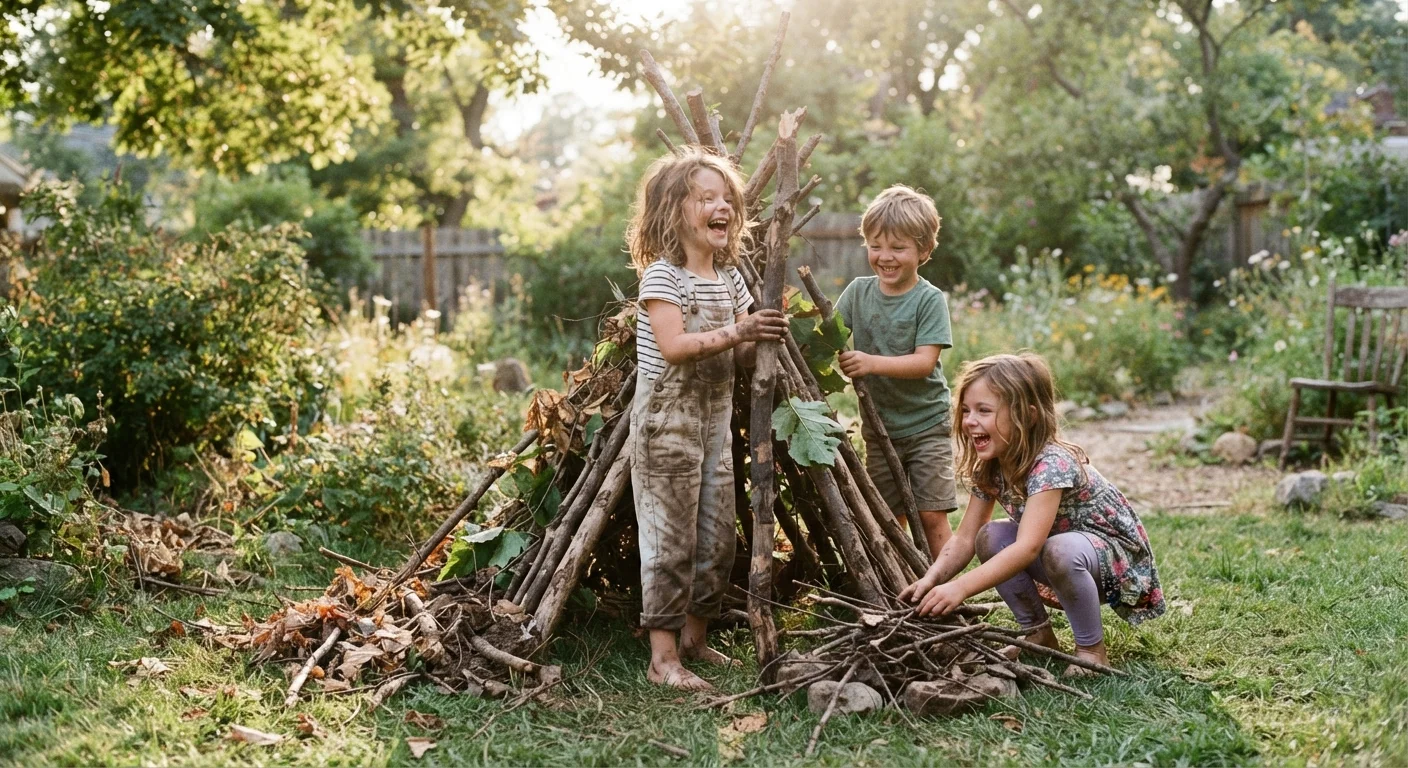
Photo credit: featuredbuzz.com
In this article
Child development research consistently points to free play as essential. Here is what it means, what it looks like, and how to encourage more of it.
Key Takeaways
- Unstructured play costs nothing and needs no special equipment or location.
- Child development researchers consistently connect free play to stronger problem-solving, emotional regulation, and social skills.
- Scheduled, screen-free blocks of time are one practical way to protect space for free play.
- Parks, backyards, and living rooms all work as settings, depending on age and weather.
- Families do not need to organize or facilitate free play, only allow it to happen.
Why free play fell off the schedule
Over the past few decades, children's daily schedules have filled up with organized activities: after-school programs, travel sports, tutoring, and structured enrichment classes. This shift happened gradually and for understandable reasons. Parents want their kids to develop skills, stay safe, and use their time productively.
The result, documented by researchers including those at the American Academy of Pediatrics, is that genuinely free, child-directed time has shrunk considerably for many American kids. More homework, more screen time, and more scheduled obligations have crowded out the hours that used to be unaccounted for. That unaccounted time is exactly what researchers mean when they talk about unstructured play.
The good news for families watching their budgets: free play costs nothing. No registration fees, no equipment, no commute to a facility.
What the research actually says
The American Academy of Pediatrics published a clinical report affirming that play is so important to healthy child development that it warrants a prescription at well-child visits. The report specifically calls out child-directed, unstructured play as distinct from adult-guided activities and describes it as a vehicle for developing creativity, problem-solving, and self-regulation.
Researchers in developmental psychology have connected free play to stronger executive function, the mental skills that govern planning, impulse control, and flexible thinking. Children who play freely with peers also practice negotiating rules, managing disagreement, and recovering from frustration without an adult mediating every moment.
25%
Decline in free play time for U.S. children
Research reviewed by child development scholars, including work cited in American Academy of Pediatrics reports, documents a substantial reduction in free play hours over recent decades, with some estimates suggesting a drop of around 25 percent or more since the 1980s.
$0
Cost of unstructured outdoor play
Child-directed play in parks, backyards, or any open space requires no registration fees, equipment purchases, or facility costs, making it one of the most accessible developmental activities available to families.
1 in 5
U.S. children with a diagnosed anxiety disorder
The National Institute of Mental Health reports that anxiety disorders are among the most common mental health conditions in American children, and multiple researchers have explored the relationship between reduced free play and rising childhood stress levels.
Physical free play outdoors carries its own set of benefits. Time in natural settings has been associated in multiple studies with reduced stress, better attention, and improved mood in children. Your local park system is one of the most accessible places to put this into practice, and public parks offer far more than playgrounds.
What unstructured play actually looks like
It can be hard to recognize because it often looks like nothing much is happening. A child stacking rocks by a creek, two siblings turning a cardboard box into a spaceship, a group of neighborhood kids inventing a game with made-up rules and arguing about those rules: all of these are free play.
The defining features are that the child chose the activity, sets the pace, and can change direction at any time. There is no score to hit, no skill the adult is trying to develop, and no scheduled end point beyond lunch or bedtime.
Start with less, not more
When setting up free play time, offering fewer materials often produces more creative results than a fully stocked activity corner. A small pile of open-ended items, blocks, fabric scraps, or natural objects gives children something to work with while still requiring them to invent the purpose. Too many choices can actually reduce imaginative engagement.
Outdoor settings tend to offer the richest material. Sticks, dirt, water, and open space are genuinely compelling to most children because they are endlessly variable. A nature scavenger hunt is one light-touch way to get kids outside, though even that involves some adult framing. True free play means handing over the agenda entirely.
Indoor free play works just as well on rainy days. The kitchen table with art supplies, a pile of building blocks, or a bin of fabric scraps can sustain hours of child-directed activity.
How families can protect time for free play
The practical challenge is not convincing families that free play matters. Most parents already sense it does. The challenge is carving out time in a schedule that has been engineered, often unintentionally, to leave none.
A few approaches that child development professionals and family researchers describe as effective:
- Block a daily screen-free window and leave it genuinely unscheduled. Do not fill it with a craft project or a suggested activity.
- Reduce the number of concurrent organized activities per child if the current load leaves no free hours in the day.
- Spend time outdoors without a plan. Walk to a park and sit down. Let children decide what happens next.
- Treat boredom as a starting point rather than a problem. Children who have no immediate option to reach for tend to generate their own activity within minutes.
Families looking for a fuller framework can explore planning a zero-cost family day, which outlines how to structure a day around free and low-cost time without over-scheduling it.
For families thinking broadly about spending less while staying engaged together, the habits discussed here connect naturally to the wider ideas in frugal family living.
Frequently Asked Questions

Author
Free Family Fun Editorial Team
Free Family Fun Editorial Team is the collective byline for our editorial team and contributor network. Articles published under this byline or an editorial pen name are researched, written, and reviewed according to our editorial standards for clarity, consistency, and independence before publication.
View all articles →